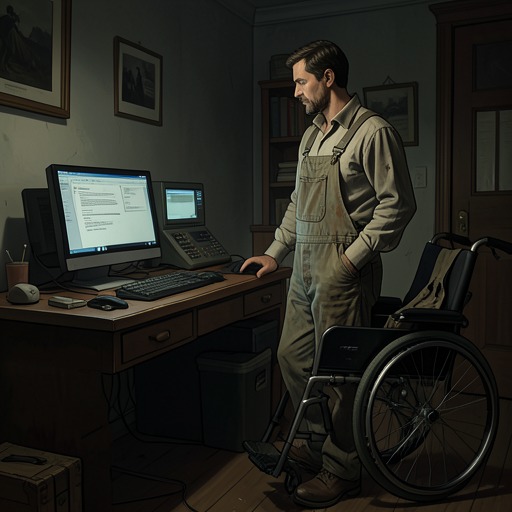
April 9–10, 2009
Mr. MercedesApril 9–10, 2009 marks the City Center job-fair massacre, the mass killing that gives the Mercedes Killer his public identity and becomes the central unsolved crime confronting retired detective K. William Hodges. The date is not merely a point in the past: its victims, publicity, and unanswered questions reach into Hodges’s retirement and help restart his investigative life.
The attack and its public record
The massacre took place at City Center, where the killer deliberately drove Olivia Trelawney’s Mercedes into a job-fair crowd. He later wrote to K. William Hodges that eight people were killed and many more wounded, and presented the attack as an act he had enjoyed. His account identifies the crime as both a mass-casualty assault and a deliberate provocation aimed at the detective who had failed to catch him.
The press’s coverage preserved a particularly charged image of the crime: the abandoned Mercedes’s steering wheel, with a yellow smile-face wearing sunglasses and showing its teeth pasted over the Mercedes emblem. The accompanying caption read, “HE THOUGHT IT WAS FUNNY.” Hodges and his then-partner Pete Huntley had asked the media not to publish the smile icon. The editor apologized for what he called a communication failure, but Huntley suspected the newspaper had used the photograph to attract readers. The image thus turned a withheld detail into a public emblem of the killer’s mockery.
The killer’s letter and Hodges’s response
In a letter to Hodges, the killer claimed that the detective had failed to catch him and recalled the massacre in celebratory terms. The letter fused the crime’s past with an immediate personal challenge: its author presented the attack as proof of his power and addressed Hodges as the person who had come closest to pursuing him. The killer’s chosen name, the Mercedes Killer, likewise links his identity to the stolen car used in the attack.
The letter’s implications disturb Hodges beyond the question of another mass killing. He considers the possibility that the killer has watched him at home while he handled his father’s .38 revolver, even wondering whether the man saw him put it in his mouth. The thought makes Hodges reconsider how exposed he has been in his living room. He also believes that if Jerome Robinson had witnessed such behavior, Jerome would have been frightened and would have spoken up. The old crime has therefore become a threat not only to the public but to Hodges’s own safety and state of mind.
From retirement to investigation
Hodges’s renewed attention to the massacre begins with documentary evidence. Looking through old newspaper stories, he finds what he wants in the Monday coverage: the photograph of the steering wheel and the conspicuous smile-face. The article’s publication matters because the detail had been withheld at the detectives’ request, and its appearance reinforces Hodges’s suspicion that the killer has used publicity to taunt the people trying to identify him.
By pursuing leads connected to Olivia Trelawney and her papers, Hodges recognizes that he is no longer acting as a police officer and is exceeding legal limits, including by withholding evidence. Even so, the killer’s arrogance has given him a renewed sense of purpose. He thinks that if he makes progress, he will turn the matter over to Pete Huntley. When Janelle Patterson later offers him a private-investigation fee of five thousand dollars a week, with an eight-week minimum, the prospect of returning to investigative work is attractive chiefly because it takes him out of retirement’s passive routine. The case also offers a continuation of work he had left unfinished when he retired.
Lasting significance
The massacre’s consequences extend well beyond the deaths and injuries described in the letter. The crime supplies the name by which the killer is known, gives him a means to taunt Hodges, and leaves a public image whose circulation the detectives had tried to prevent. For Hodges, the date marks both a professional failure and the beginning of a new purpose: the unsolved attack pulls him back toward investigation, even as it makes the danger personal.